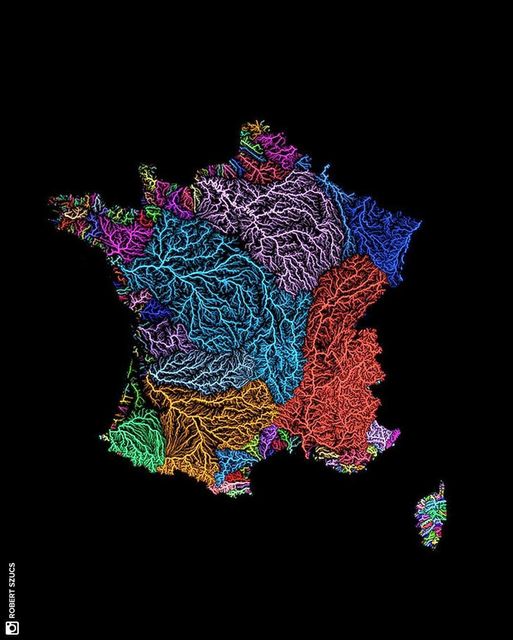
As throughout the world, there’s always been a direct link between water and the wine regions of France. As one follows the flow of water, one can understand how wine regions were formed centuries ago. Vineyards have always be affected by water, from the coast and from the rivers and lakes lying within. Water has a direct impact on temperature and climate, determining which grape varieties can be cultivated and thrive in a particular environment as well as the styles of wine that can be crafted.
For example, looking from the east, due north of Montpellier to the west in direction of Bordeaux, the Ariège, Tarn, and other tributaries (orange) rejoin the Garonne river and the Atlantic Ocean. In the Pyrenees Piedmont, tributaries meet up with the Adour river (green) and travel all the way to Bayonne and the coast, just north of Biarritz and not far from the Spanish border.
Taken together, as the water flows (green and orange), you have what’s close to a perfect presentation of the vineyard of Southwest France!
Panel discussion 18:00 CET (Paris) / 12:00 EST Tasting: 19:00 CET (Paris) / 13:00 EST (see below for wines)
This is the first of a series on wine webinars by the EACC Southwest’s new wine committee.
Isn’t rosé a girly wine? Never pair red wine with seafood. Champagne is only for celebrations.
Stereotypes–they beset the wine industry. But aren’t stereotypes meant to be broken? Why can’t wine lovers be left alone to discover without judgement? Then again, it’s often the consummate wine drinker who sets the tone, with their cherished terroir.
This webinar brings together wine professionals who have heard it all. Fixed beliefs or myths that set barriers for certain wines and pigeonhole drinkers into narrow demographics, from bag-in-box Gen Z to Chardonnay, desperate housewives. And what explains the European’s reluctance towards American wine?
The panel will look at what’s behind these stereotypes, from a cultural and business perspective. Hopefully, the discussion will open your senses to consider new experiences, even if it’s as sacrilegious as rosé in the winter.
Fabien Olaiz is export director at Plaimont, a wine producer and cooperative located in Southwest France that includes the brands Saint Mont, Pacherenc du Vic-Bilh, Madiran and IGP Gascogne. Olaiz works closely with the winemakers and growers. He’s cultivated long-term relationships with medium to large importers, along with high-end clients such as Michelin-starred restaurants. Today, he focuses on the US and China markets.
Evelyne Resnick, Ph.D is a researcher and professor at ISG Bordeaux Business & Management School, focusing on innovation marketing for luxury wines and brands in international markets. She co-founded Resmo, a French American consulting firm specializing in luxury wines and brands for the American and Asian markets. She has also authored several books.
Jean-Louis Carbonnier is the founder and president of Carbonnier Communications, a boutique marketing and sales firm in Brooklyn, New York specialising in terroir-based and traditional food, spirit and wine products. He has an extensive network of importers, distributors, buyers and influencers. Carbonnier is the Director for the Americas at Château Palmer, a wine estate in the Margaux appellation of Bordeaux.
Ludwig Vanneron is a Bordeaux-based enologist providing vine and wine consultancy. He founded Oenosmart, which brings solutions to the wine business sector including production–winemaking, vineyard management, winery construction project. The company also does branding, marketing, and global strategy in wine and spirits, especially Cognac and Bourbon whiskey. Vanneron is the winemaker behind SOL BENI, a Saint-Emilion red wine.
Moderated by Bradley Stock, Vice President of EACC Rhône-Alpes. He is the founder and CEO of LingoFacto, a strategic communications firm that specializes in public speaking. Brad works with opinion leaders and high-level executives to help them forge key messages that foster change. A wine lover himself, Brad has been a member of a wine-tasting club for over 20 years attending more than 100 meetings
The Madiran – Pacherenc du Vic-Bilh appellations are struggling after the cancellation of their open house which has been taking place in November for nearly twenty years. But they are not giving up and betting on a rebound of wine tourism in 2021.
“Orders are having a hard time taking off even with free shipping”, admits President Pascal Savoret. “But we are trying to increase the visibility of the domains by relaying information from our winemakers, especially in terms of pickup options or free deliveries. There are already more than fifteen of them present on the site (madiran-pacherenc.com) and those who participate can showcase their wines”. A handful of producers took advantage of the site at the beginning of 2020, many have joined in recent months or are the process of joining. This year’s boosted communication on the internet has proved effective with good results: Madiran has made a good comeback in terms of searches and hits and Pacherenc has made strong progress. This reflects the market, with Madirans holding their own in a struggling market for reds and Pacherenc progressing in a declining “sweet” context. The 19th Barrique d’Or auction took place virtually for the first time mid-November; it featured fifteen lots (the Barrique d’Or purchased by a Florida importer was a windfall for Anne and Fabrice Latapi who were participating in the event for the first time).
The appellation still intends to gain momentum on the web in 2021 with a change in community management that will be managed by a digital agency based in Pau, Zébrure, in collaboration with the Côtes-de-Gascogne and Saint-Mont appellations (website, Facebook, Instagram). Over the past year, communication has also been strengthened with a new slogan “Southwest Living” and a spiral logo, in a press release “to highlight Southwest Living and increase our notoriety”.
Reconquering local customers
“Although public tours have been cancelled, cellars will remain open in December,” insists Pascal Savoret. But we have to admit that people are not moving around much and there will be a decline in tourists who used to stop at our place to buy a few bottles on their way down from the ski resorts or spas”. The Hautes-Pyrénées Chamber of Agriculture has set up several farm drive-throughs for wine growers and cellars in Lourdes, Tarbes, Pau…where their wines can be sold” but that will not compensate the loss in sales from restaurants, [one out of every four bottles sold], and a general decline in consumption due to the pandemic at a time when families usually get together for a nice meal. It’s not surprising that wine shops in these big cities are running in slow motion”. Various events and tastings are being planned for next year in order to re-conquer the Toulouse market and other regional cities such as Pau and perhaps Biarritz. The appellation also partners with Southwest Wine Syndicate (IVSO) for major trade shows such as Wine Paris or tastings organized at wine shops and could even join forces with neighboring appellations like Irouléguy and Jurançon.
Notwithstanding in 2021, Madiran and Pacherenc will focus on wine tourism with a new reception room at its Maison des Vins. Work had been delayed due to the pandemic, but it should be operational by spring. A communications and wine tourism manager, currently being recruited, will be in charge of reorganizing the teams and generating new ideas “because in normal times, wine tourism represents 20% of our sales. Proof of this is the high attendance at the wineries this summer despite the cancellation of our wine festival and Jazz in Marciac”. The redevelopment of the Château de Crouseilles with its escape game, hiking trails and “sensory” paths has reinforced the attractiveness of the surroundings, as have the many events proposed by Alain Brumont (photo below), the Château de Viella… and we hope the forthcoming reopening of the Prieuré, a luxury hotel and gourmet restaurant located on the town square of Madiran .
Born in France and made famous by Argentina, malbec is a wine whose star is still on the rise. Here’s what you need to know about its production. Plus, we suggest five of the best bargain bottles to try.
PUBLISHED 17 DEC 2020, 08:00 GMT (National Geographic)
Although it has its origins in France, Malbec is often associated with Argentina, where the high altitude and semi-arid desert conditions of Mendoza are an ideal terroir for the grape. PHOTOGRAPH BY GETTY IMAGES
One of the first wines to capture my imagination was Cahors, from Southwest France, where it’s known as ‘black wine’ because of the intensity of its colour. It seems a shame, therefore, that there’s now a tendency for producers from the region to put the name of the grape front and centre on their labels, rather than that of the region. The reason? Cahors wines must have a minimum of 70% malbec, and they’re hoping to capitalise on the grape’s growing popularity.
Despite the malbec grape being native to this part of France and having a long history in local winemaking, it’s primarily associated with Argentina, the world’s biggest exporter of malbec wine. The variety found in the South American country — to which malbec cuttings were imported, via Chile, in the mid-1800s — comes from stock that predates phylloxera, a blight that decimated French vineyards later that century, and from slightly different clones than those still prevalent in its homeland.
The high altitude and semi-arid desert conditions of Mendoza, where most of Argentina’s grapes are grown, act as an ideal terroir for the grape — and the reliable combination of perfect ripeness and supple tannins has made Argentinian malbec one of the most popular reds on the market. It’s produced in other parts of South America, too: over the border in Chile, for example, and in Peru (for a fresh, fragrant taste from Peru’s Ica Valley, try Santiago Quierolo’s Intipalka Valle del Sol Malbec 2018, sold by Corney & Barrow). And while there are malbec producers elsewhere in the world, including South Africa and Australia, the grape’s other main growing region is still France, where it’s also known as auxerrois or côt noir.
In Bordeaux, Malbec is mainly used as a blending component, although it’s increasingly bottled on its own. The grape thrives further south, too, with producers in the Languedoc region creating wines in a fresher, juicier style (Martinfort Malbec 2018, from Shropshire-based Tanners, is very easy-drinking).
These days, it’s not uncommon for French winemakers to take advantage of Argentina’s near-perfect weather conditions (by teaming up with South American producers or launching their own overseas operations) in order to produce malbecs with more finesse than could be achieved back home. Château Lafite Rothschild, for example, has joined forces with top producer Nicolás Catena Zapata to run the Bodegas CARO winery, and luxury brand LVMH (owner of Moët & Chandon) has established the Bodegas Chandon wine estate.
Master of Wine Tim Atkin, who authors an annual guide to Argentinian wines, claims “the best is yet to come” for the country’s reds. And with this high acclaim in mind, it might be best to stock up on malbec while it’s still affordable.
Five bottles of malbec to try
Tesco Finest Cahors Mabec 2018, Cahors, France It’s somewhat surprising to find this more traditional style of malbec available in the Tesco Finest range. Sealed with a cork rather than a screw cap, it offers a glimpse of old-style rusticity. £7.50.
Domaine de la Pépière La Pepie Côt 2019, Loire Valley, France A slightly funkier incarnation of malbec from the Loire, where the grape variety is known as côt. Bright and brimming with fruit. Drink chilled with charcuterie or steak frites. £12.99.
Château Rambauds Malbec 2018, Bordeaux, France It’s rare to find a wine from Bordeaux that’s 100% malbec. This one has real elegance for the price. It’s a classic wine for a Sunday roast that will go down well with claret-lovers. £9.
Terrazas de los Andes Malbec 2017, Mendoza, Argentina A textbook Argentinian malbec, with plum, cherry and blueberry and smooth, velvety tannins. It’s hard to find a more gratifying red for the price. Steak is the obvious pairing. £16.99.
Licanten Idahue Estate Malbec 2017, Curicó Valley, Chile This beautifully perfumed Chilean malbec has a more overtly fruity style than typical Argentinian offerings. Pair it with duck or other game; it could even handle a touch of spice. £13.95.
Published in Issue 10 (winter 2020) of National Geographic Traveller Food



 Sud Selections